
Clause 1.1, read carefully
Bitsler: the one row in this table with no licence number
Bitsler prints no licence number. Clause 1.1 says Oyine N.V. works under a Certificate of Operation while application OGL/2024/930/0387 is in progress with the Curaçao Gaming Control Board. An application number and a licence number look alike, and treating 1 as the other is the error this row exists to prevent.
The number that is not a licence number
Every other row in this table carries a licence number. This one carries an application.
Clause 1.1 of the terms says Oyine N.V. operates with a valid Certificate of Operation, that an application, OGL/2024/930/0387, for a gaming licence is in progress with the Curaçao Gaming Control Board, and that until that process concludes the company is permitted to continue operating under the Certificate on the basis of a transitional arrangement. The Certificate itself is stated to be subject to the National Ordinance on Offshore Games of Hazard, P.B. 1993 no. 63.
The operator wrote all of that itself, and it is more candid than most.
The trap is what happens next, in other people’s tables. A string shaped OGL/2024/930/0387 is indistinguishable at a glance from the licence numbers in the rows above, and copied into a comparison column it reads as one. Our table prints “no number” in this row for exactly that reason. What a register entry proves, and how a number outlives the thing it stood for, is unpacked on the page about operator documents.
Nothing here says the operator is doing anything improper. It says the document it holds is a different kind of document, and a reader deserves to be told which.
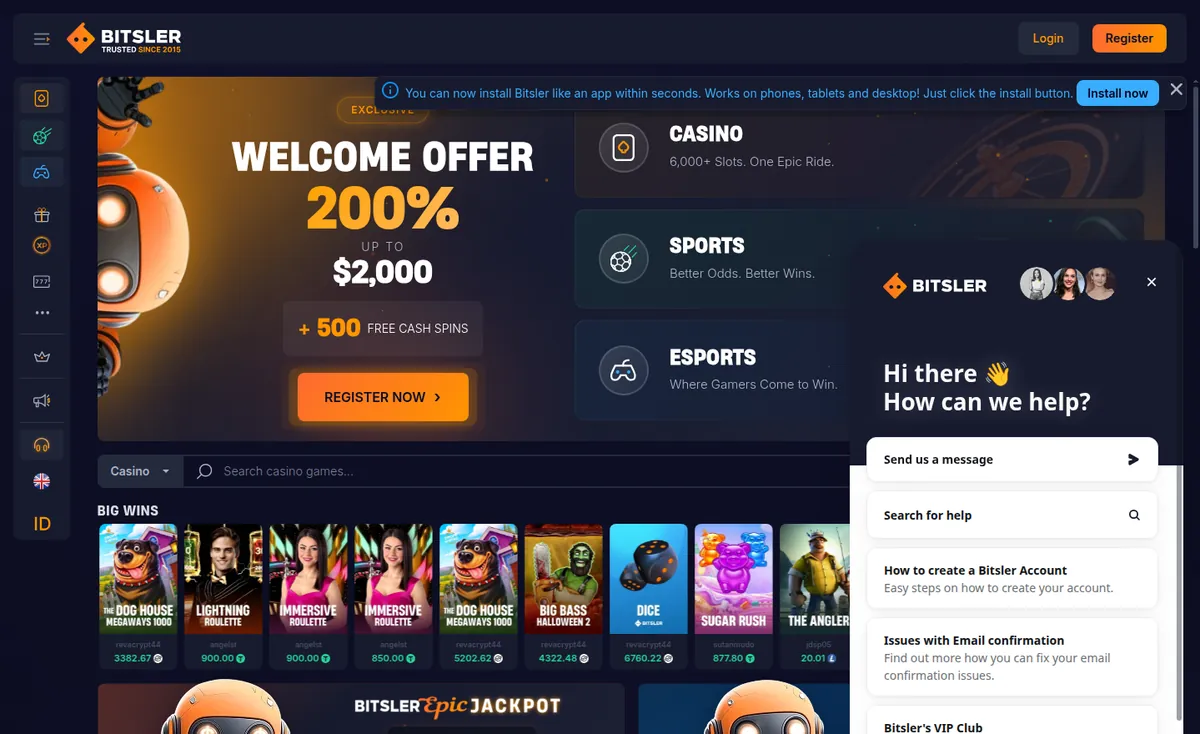
Eleven years, and what that does not settle
The service states 2015 as its launch year, making it the second-oldest address in our ten after Cloudbet.
Longevity is a fact, not a document.
Separating those two is worth the sentence, because writing about crypto casinos usually presents them as one argument. A launch year says a service survived on the market for a decade. It says nothing about the amount at which documents will be demanded, how long a payout takes, or the standing of a register entry — and in this row the register entry is precisely the item still in progress.
Documents on demand, checked by a third party
The identity clauses are 4.3, 4.4 and 8.22, and they publish no threshold.
The operator reserves the right to ask for proof of age and satisfactory identification to authenticate registration details and to comply with anti-money-laundering legislation, and separately to require further identification or proof of source of wealth or source of funds at any time — notably on large deposits, where it is concerned about a level of spend, or where it suspects funds obtained from criminal activity.
None of those triggers is attached to a figure.
The procedure is described in more detail than the trigger. Verification is handled by a third-party service named Veriff, in two phases: identity always, proof of address on some occasions. The documents wanted are a photograph of the front and back of a valid identification document taken during a recorded video session, a selfie, and a proof of address — an internet, electricity or phone bill, or a bank statement — no older than three months, with all four corners, the name, the address and the company logo visible.
Clause 4.4 sets the consequence: where age, identity or address cannot be verified to the operator’s satisfaction, the account is suspended until the information is provided, and the operator reserves the right to reject documents submitted and demand further ones. No deadline for supplying them appears in the terms or the help centre, and a blank there means we found none rather than that none exists. The comparison across all ten stands on the page about casinos without identity checks.
“Instant withdrawals”, and the clause underneath
The help centre says withdrawals here are instant. Clause 8.15 says something less definite: the time between requesting a payout and the funds being available may vary depending on the cryptocurrency and the load on the blockchain network.
No numeric processing time appears in the terms at all.
The help centre adds that a payout is instant unless flagged Pending — a manual check by the operator or a game provider — or On Hold, where suspicious behaviour is detected, and gives no duration for either state. So the word instant describes the ordinary path and stops describing anything the moment a check begins. We tested no payout with our own money and record the claim as the operator’s.
No per-period ceiling is published. Clause 8.6 reserves the right to assign minimum and maximum withdrawal levels, communicated at the time of the transaction, without printing a figure. Clause 8.13 requires deposits to have been wagered at least once, and reserves the right, on a large request, to pay winnings in instalments over time and to make the payment in BTC, ETH or USDT at the operator’s sole discretion — with the size of a large request left unnamed. Clause 8.14 requires payouts to return by the deposit method, splitting them across methods where several were used. The help centre puts the minimum payout at approximately 10 USD. Clause 8.18 voids all bets and winnings and closes the account permanently where a double-spend methodology is detected.
Icons where a coin list should be
Our coins column says “not published”, and the reason is a design choice on the operator’s own site.
The footer carries a strip headed with the coins accepted at Bitsler, and it renders as icons with no text. The cashier sits behind a login. Clause 8.2 hands the question to the site: available cryptocurrency options for deposits and payouts are listed on the website and may differ from time to time depending on jurisdiction.
The operator does issue a token of its own, BTSLR, used in free challenges.
So we have a token we can name and a list we cannot count, and the column says so. The homepage claims a slots figure rather than a game count, and prints no supplier total; neither number reaches this page, because neither is a term. We read the list of excluded countries on 26 August 2026 in the terms at bitsler.com/en/tos, and Poland was not on it. What a coin count measures is unpacked on the page about casinos that take cryptocurrency.
What this means for a reader in Poland
A pending Curaçao application is not a Polish permit, and neither would a granted licence be. Internet casino games here are covered by a state monopoly, so nothing issued in Curaçao has a Polish counterpart. The arithmetic behind that stands on the page about the lawful online casino.
On the player’s side, art. 107 § 2 of the Fiscal Penal Code applies regardless of which document an operator holds abroad, and art. 109 covers the same conduct from another angle. Both are quoted on the page about what the statute says.
We hold no account with this operator and describe no payout from experience.