
One field, one answer
Searching a domain, and what the entry sets in motion
The Polish register of banned domains has run since 1 April 2017, holds 1 search box and answers 1 question. Looking a domain up takes seconds, and an entry triggers 2 separate duties falling on 2 separate kinds of company.
Ten casinos that hold no Polish permit. Every column is copied from the operator’s licence record and from the operator’s own terms, never from an opinion. A blank cell means the figure is not published — it never means zero and it never means “no limit”.
- Vave
-
- LicenceCuraçao Gaming Authority
- Before papers are asked forat discretion
- Coins90
- Bitcasino.io
-
- LicenceCuraçao Gaming Authority
- Before papers are asked for2,500 EUR
- Coins12
- DuckDice
-
- LicenceAnjouan Gaming Board
- Before papers are asked forat discretion
- Coins10
- Empire.io
-
- LicenceAnjouan Gaming Board
- Before papers are asked for2,000 USDT
- Coinswe did not read it
- Metaspins
-
- LicenceCuraçao Gaming Authority
- Before papers are asked forat discretion
- Coins9+
- Rainbet
-
- LicenceAnjouan Gaming Board
- Before papers are asked forat discretion
- Coins9+
- Shuffle
-
- LicenceCuraçao Gaming Authority
- Before papers are asked forat discretion
- Coins20
- Wild.io
-
- LicenceCuraçao Gaming Authority
- Before papers are asked forat discretion
- Coins12
- Bitsler
-
- LicenceCuraçao no number
- Before papers are asked forat discretion
- Coinswe did not read it
- Cloudbet
-
- LicenceCuraçao Gaming Authority
- Before papers are asked forat discretion
- Coins40


Vave buys the one link that leaves these pages, and that purchase is the whole of the arrangement. Its terms set a deadline rather than a promise: clause 8.1 gives the operator up to 3 days to deal with a payout request, and clause 8.8 says that anything above 50,000 USDT leaves in equal instalments over as much as 30 days. We looked its licence number up ourselves on 2 September 2026 in the Curaçao Gaming Authority register: OGL/2024/1676/0905, held by Latcas B.V., issued 19 May 2025, status active.
What kind of document this is
Ministerstwo Finansów, the Ministry of Finance, keeps the Rejestr Domen Służących do Oferowania Gier Hazardowych Niezgodnie z Ustawą — the register of domains used to offer gambling contrary to the Act. Art. 15f of the Gambling Act is its basis, and the first entries arrived in the spring of 2017.
It sits at hazard.mf.gov.pl, it is open to everyone, and it asks nobody to log in.
An entry means an instruction addressed to internet access providers: block access to that domain. Payment services providers get their own instruction: stop payments going to it. This is an administrative order to companies, not a penalty imposed on a player. What a player faces, and under which provision, is set out on the page about what the statute says.
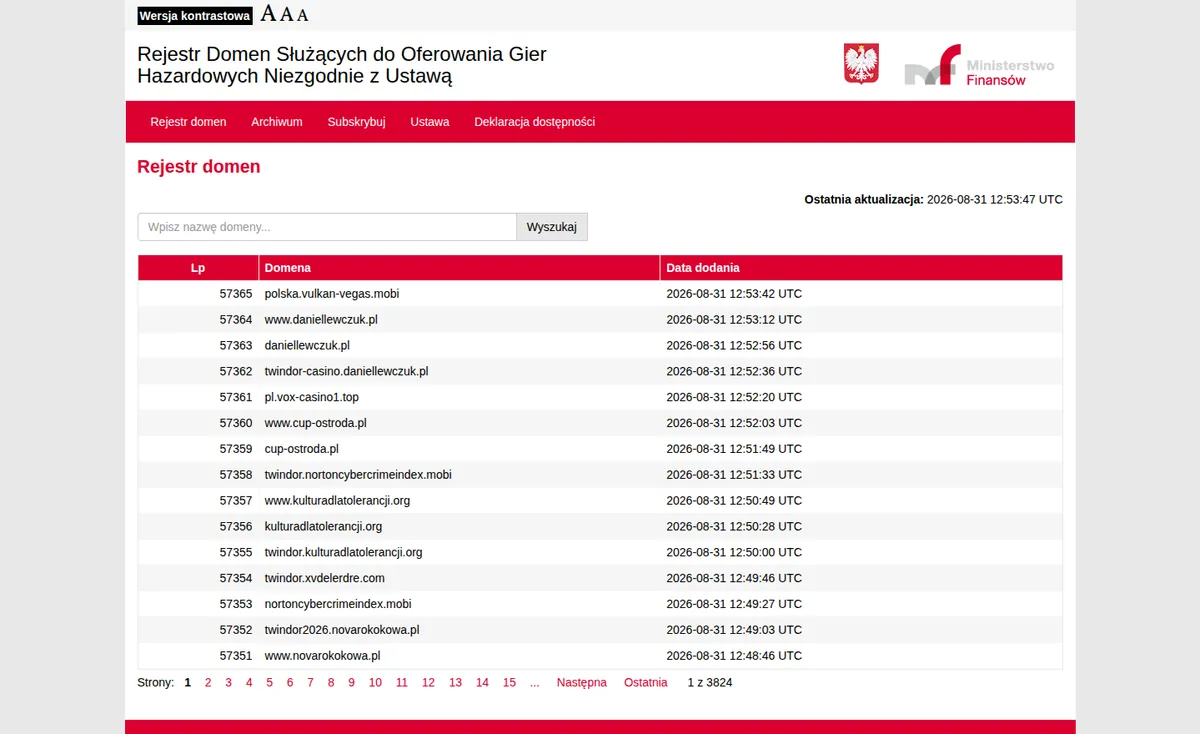
How to search a domain
Four steps, and none of them needs anything beyond a browser.
- Open
hazard.mf.gov.pl. The search box sits in the main view: one text field with a button beside it. - Type the bare domain, without
https://and withoutwww. The register works with domain names, not with the addresses of subpages. - Read the answer. The result is binary: the domain is listed, or it is not.
- Try the spelling with a hyphen and without one, if the operator uses both. Entries cover particular names, not a brand as such.
Seconds per domain.
The result repays being read literally. An answer of “not listed” concerns the string you typed, on the day you typed it, and says nothing about whether the operator holds a permit anywhere on earth, nor about how its terms read. This is one answer to one question asked about one address.
Doing it again for every new domain is worth the trouble, because the register grows. Operators answer an entry by launching another name, and a new name reaches the register with a delay, so the absence of an entry today says nothing about a month from now. Searching is a repeatable act rather than a one-off.
Two duties, not one
The register is not a warning list. It is a document that particular duties follow from, and they fall on two entirely different industries.
Internet access providers have to make the listed domain unreachable. In practice that means a redirect to an information page of the Ministry of Finance instead of the site requested.
Payment services providers have to stop payments to the entity behind that domain. The second duty tends to be less visible and can bite harder: the page may open while the transfer bounces.
Two independent mechanisms, both set off by one entry.
Keeping them apart explains a situation readers find contradictory: the service works, the account works, and a card payment or a transfer bounces with no explanation. One of the two instructions took effect; the other has not yet.
What the player sees
In the usual case, a notice where the page should be. It looks like a fault and is not one, which misleads anyone meeting it for the first time.
An information screen is not a penalty imposed on the reader.
Saying that plainly is worth the sentence, because it gets read the other way round: an entry in the register is an instruction to telecoms companies, not an administrative decision against the person who typed the address. The player’s own exposure comes from a wholly different document, the Fiscal Penal Code, and would exist even if the register had never been created.
What happens to payments when an account already exists
The payment block runs towards the operator and covers transfers made to it. It is not a freeze on the player’s bank account and it is not a seizure of funds.
From this comes the distribution of payment methods across this market.
Domestic ways of paying in złoty work where a lawful online casino with a permit stands, because they travel through the very providers the duty binds. On the other side what remains is mostly cryptocurrency, and that is a consequence of the mechanism rather than a merit of the technology. What such a change of cashier really alters is taken apart on the page about casinos that take cryptocurrency.
Getting money out of an account with an operator follows its own rules, though, written into the terms rather than into Polish legislation. How much may be withdrawn and over what period is covered on the page about operator documents.
What the register will not answer
Knowing what you cannot read out of this tool is half of its value.
It will not say whether an operator pays wins out. It will not say how long a payout takes or what the limits are. It will not say which documents a casino demands at the first sizeable amount. Nor will it say whether the operator accepts players from Poland at all, and that is surprisingly often a separate answer, written by the operator itself into its own terms.
The register answers the question about a permit. About nothing else.
Eleven of the thirty-eight sets of terms we read name Poland on a list of excluded countries. That makes none of those operators more unlawful than the rest; they simply decline a Polish account. When an operator demands documents, and what happens to an account with no real data behind it, is shown on the page about casinos without identity checks.
The register knows domains, not brands
This distinction decides whether searching makes any sense at all.
An entry covers one particular domain name, not a company and not a brand. A single operator can run several addresses at once: the main one, a spare, a version with a hyphen in the name, and a separate domain for the app. Listing one of them does not list the others.
So the address you check is the one actually standing in the browser bar.
Apparent novelty comes from the same place: a fresh address can be absent from the register purely because an entry covers a domain, while the company behind it may be the one that was already there. What genuinely turns out to be new in such a case is worked through on the page about new online casinos.
A result for the domain an advertisement points at says nothing about the domain that advertisement redirects to. If the address changed after the click, the second one is what needs checking. The ten casinos in our table are ten separate names rather than ten companies, and they deserve the same treatment when searched.
The scale of this can be counted from the other side, in the licensing registers. Across a base of a hundred brands, a licence number is quoted by 67, yet only 52 distinct numbers exist, because nine entries serve several sites apiece. The Anjouan number ALSI-202508056-FI2, issued to Novatrix SRL, goes furthest: five separate services stand behind it, with five separate addresses.
One company, one licensing entry, five names to look up one at a time.
The Polish register works with domain names rather than company names, so nothing in it lets you derive the other four results from one. Who covers how many brands with a single number is taken apart on the page about operator documents.
Register and country list: two different refusals
A player in Poland runs into two refusals that look alike, come from entirely different places and take effect at different moments.
The refusal by the state is visible at once. An entry can be checked before opening an account, in seconds, with nothing held at the operator. It changes as the register changes, it is public, and it concerns an address rather than a person.
The refusal by the operator stays invisible until payout time. It is written into its own country list, reachable through the terms, and shown to nobody at sign-up.
We read such lists at 38 brands. Poland stands on 11 of them, and the length of those eleven lists is spread very unevenly: six cover between 216 and 224 countries, which is nearly the whole world, while five range from 34 to 92 entries.
The shorter list is the stronger signal of the two.
The practical order follows from that by itself. The register comes first, because it takes seconds and demands nothing. The country list comes second, because it demands opening the terms — yet it is the one that decides what happens to money in the account. Third comes the clause on documents, described on the page about casinos without identity checks.
What we did not check in the register ourselves
Our table carries no column headed “listed”, and that is a decision rather than an oversight.
We did not run a hundred domains from our base through the search box.
The reason is plain: such a column would age faster than every other. The register grows, operators launch further addresses, and a result read once describes the day of reading rather than a lasting state. A column dated a month ago would look like information while being a memory.
The other columns do not behave that way. A licensing entry number, a clause number in the terms and a country list change more rarely, and each of ours carries the date of reading and the address of the document, where a reader will see the same thing.
Searching the register therefore stays on the reader’s side, and not because it is difficult. It is the only act on this list anyone can perform alone in seconds, for nothing, without opening an account anywhere.
The second thing the state publishes
Beside the domain register, Ministerstwo Finansów keeps a list of the entities that do hold a permit. Those two documents are read together: the first says who has been blocked, the second says who operates lawfully.
Without the second, the first is only a list of names.
For an online casino the list is very short in practice, because internet casino games fall under a state monopoly in Poland. Permits outside the monopoly concern betting, which is a different product, however thoroughly a search engine mixes it with the casino.
The same idea next door
A domain register is a standard regional device, so knowing what it gets compared with is useful.
The Czech Ministerstvo financí keeps its own list under § 84d of the Czech gambling act, named Seznam nepovolených internetových her. It sits at mf.gov.cz in the section on the supervision and regulation of games, and it is refreshed weekly.
The construction is identical: the state publishes a list of addresses, and the duty to act falls on providers.
The difference lies outside the register, in the provisions about the player, and it is fundamental. The Czech provision on participation concerns the operator’s own staff; Polish art. 107 § 2 concerns anyone taking part in a foreign game of chance on the territory of the country. Both wordings stand side by side on the page about what the statute says.
Where this subject stops
It will not show how to get past a block. It will not name methods, describe them, or warn against them in a way that amounts to an instruction written backwards.
That is not editorial caution but the boundary of the subject: a page about how to check a document stops being itself the moment it starts explaining how to evade one. The same rule holds on every other page here and belongs to the method described under how we read documents.
Anyone looking for help with gambling will find a free helpline at Krajowe Centrum Przeciwdziałania Uzależnieniom on 801 889 880, daily from 17.00 to 22.00, weekends included.