
Quoted in full, not summarised
Four provisions, and two of them are aimed at the player
4 provisions decide this whole subject: 2 concern the player, 1 concerns the operator, 1 created the domain register. Each is set out below in its statutory wording, with the address it was read at and the date of reading, 1 September 2026.
Ten casinos that hold no Polish permit. Every column is copied from the operator’s licence record and from the operator’s own terms, never from an opinion. A blank cell means the figure is not published — it never means zero and it never means “no limit”.
- Vave
-
- LicenceCuraçao Gaming Authority
- Before papers are asked forat discretion
- Coins90
- Bitcasino.io
-
- LicenceCuraçao Gaming Authority
- Before papers are asked for2,500 EUR
- Coins12
- DuckDice
-
- LicenceAnjouan Gaming Board
- Before papers are asked forat discretion
- Coins10
- Empire.io
-
- LicenceAnjouan Gaming Board
- Before papers are asked for2,000 USDT
- Coinswe did not read it
- Metaspins
-
- LicenceCuraçao Gaming Authority
- Before papers are asked forat discretion
- Coins9+
- Rainbet
-
- LicenceAnjouan Gaming Board
- Before papers are asked forat discretion
- Coins9+
- Shuffle
-
- LicenceCuraçao Gaming Authority
- Before papers are asked forat discretion
- Coins20
- Wild.io
-
- LicenceCuraçao Gaming Authority
- Before papers are asked forat discretion
- Coins12
- Bitsler
-
- LicenceCuraçao no number
- Before papers are asked forat discretion
- Coinswe did not read it
- Cloudbet
-
- LicenceCuraçao Gaming Authority
- Before papers are asked forat discretion
- Coins40


Vave buys the one link that leaves these pages, and that purchase is the whole of the arrangement. Its terms set a deadline rather than a promise: clause 8.1 gives the operator up to 3 days to deal with a payout request, and clause 8.8 says that anything above 50,000 USDT leaves in equal instalments over as much as 30 days. We looked its licence number up ourselves on 2 September 2026 in the Curaçao Gaming Authority register: OGL/2024/1676/0905, held by Latcas B.V., issued 19 May 2025, status active.
Two provisions aimed at the player
Poland belongs to the minority of EU countries where taking part in a game run by an operator without a domestic permit is a punishable act for the participant. That is what the kodeks karny skarbowy, the Fiscal Penal Code, promulgated as Dz.U. 1999 nr 83 poz. 930, provides — and it is worth knowing before anything else on this subject.
Art. 107 § 2: „Tej samej karze podlega, kto na terytorium Rzeczypospolitej Polskiej uczestniczy w zagranicznej grze losowej lub zagranicznym zakładzie wzajemnym.”
In English: the same penalty applies to whoever takes part, on the territory of the Republic of Poland, in a foreign game of chance or a foreign betting arrangement. The same penalty means the one set out in § 1 of that article: a fine of up to 720 stawki dzienne, day-fine units, or imprisonment of up to 2 years, or both together. Paragraph 4 provides that in a case of lesser gravity the person answers for a fiscal misdemeanour, meaning a fine with no custodial element.
Art. 109: „Kto uczestniczy w grze losowej lub zakładzie wzajemnym urządzonym lub prowadzonym bez wymaganego zezwolenia albo wbrew jego warunkom, podlega karze grzywny do 120 stawek dziennych.”
In English: whoever takes part in a betting arrangement or a game run without the required permit, or against the conditions of that permit, faces a fine reaching 120 day-fine units.
Two provisions, two different ceilings, one behaviour described from two sides.
What separates them is the description of the game, not the description of the participant. Art. 107 § 2 speaks of a foreign game; art. 109 speaks of a game run without the required permit or against its conditions. An online casino operated from outside Poland answers both descriptions at once, and which of the two applies is for a court to settle.
What that comes to in złoty
It cannot be stated, and any text that supplies a concrete sum supplied it from nowhere.
A day-fine unit is not a fixed amount. A court sets its value individually in each case, within a range tied to the minimum wage, weighing the person’s income and their family and financial circumstances. Only afterwards does it multiply that value by the number of units imposed for the act.
The statute therefore gives a maximum count of units, not a maximum amount.
That is why this page says “up to 720 day-fine units” and offers no conversion into złoty. A conversion would be guesswork resting on two unknowns at once: the value of a unit and the number of units. Both are settled after the fact, in one particular case.
A fiscal offence and a fiscal misdemeanour are two different things
The three fragments quoted above describe one behaviour and attach three different consequences to it. That is not an inconsistency in the drafting; it is how this particular Code is built.
Art. 107 § 1 puts the upper bound of the fine at 720 units, allows imprisonment of up to 2 years alongside it, and allows both to be imposed together, and § 2 refers back to it expressly. Paragraph 4 of the same article moves an act of lesser gravity into the category of fiscal misdemeanours, where no custodial penalty exists. Art. 109 stops at 120 units and nothing else.
The ceiling in one provision is therefore six times the ceiling in the other.
Which classification applies is settled by a court in the individual case, weighing the circumstances of the act. The statute supplies no monetary threshold, no count of sessions and no other test a reader could apply to themselves before depositing.
That is why no sentence of the form “at this stake you face that” appears here. Such a sentence would need two figures absent from the provisions and a third one settled only afterwards. We have read no judgments in these cases either, so we have no basis for saying how the provisions work in practice, and we do not say it.
Four things these provisions never mention
Both sentences repay a second reading, this time for what is missing from them. The list of absences explains most of the confusion around the subject.
Not a word about the internet. Art. 107 § 2 describes participation on the territory of the Republic and names no channel by which the game reaches the player; art. 109 describes a game organised outside the required permit and names no channel either. Both sentences describe conduct rather than technology, which is why searching them for the word online ends in nothing.
Nothing about payment method or currency. A transfer in złoty and a transfer in coin fall inside the same description, because the description does not concern the money staked at all.
Nothing about opening an account, and nothing about the length of a form. The provision speaks of participation in a game, not of the steps preceding it.
Not a word, finally, about the operator’s foreign permit. A number from Curaçao or from Anjouan appears in these sentences in no form whatever, so it shifts their application in neither direction.
Four absences, one shared cause.
The provision describes the player’s conduct, not the properties of the service the player uses. Every operator characteristic readers ask about is settled in other documents: in the register of the jurisdiction that issued the number, and in the terms the player accepted. What can be read out of those is shown on the page about operator documents.
One provision aimed at the organiser
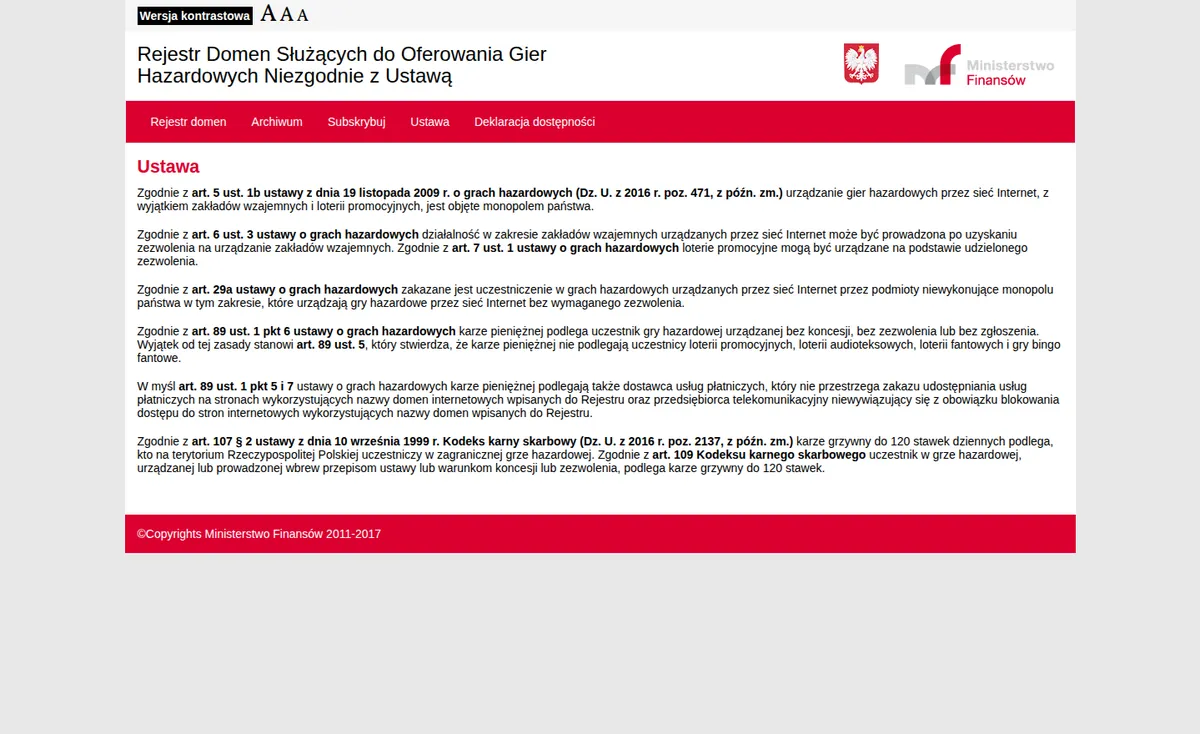
The Gambling Act of 19 November 2009, art. 29a, forbids running gambling games over the internet without the required permit.
Online casino games in Poland fall under a state monopoly. Outside that monopoly a permit is issued for betting alone, and this follows from art. 5 ust. 1b of the same statute.
That is where the phrase this site is named after comes from. An online casino without a Polish permit means, in practice, every online casino but one, because no permit for an online casino is ever issued here. Who operates on the other side of that line, and on what basis, is set out on the page about the lawful online casino.
The fourth provision: where the domain register came from
Art. 15f of the same Act is the basis for the Rejestr Domen Służących do Oferowania Gier Hazardowych Niezgodnie z Ustawą. Ministerstwo Finansów, the Ministry of Finance, keeps it, and an entry creates duties for two industries: internet access providers have to make the listed domain unreachable, payment services providers have to stop payments going to it.
This is an instruction to companies, not a decision addressed to whoever typed the address into a browser.
The distinction looks like pedantry and is not: the player’s exposure comes from the Fiscal Penal Code and would exist even if the register had never been created. What the search itself looks like is shown on the page about the register of banned domains.
Why Czechia handles this differently
The comparison is worth making, because writing on gambling likes to invoke a single European practice, and practice differs between two neighbouring states.
The Czech zákon č. 186/2016 Sb. lists, in § 122, the offences of persons who are not the organiser of a game. One letter there concerns participation: § 122 odst. 1 písm. b) punishes anyone who „se účastní hazardní hry v rozporu s § 7 odst. 5”, takes part in gambling contrary to § 7 odst. 5. And § 7 odst. 5 concerns a person who performs duties for the organiser connected with running the game, and who plays where those duties are performed.
The Czech provision on participation therefore speaks about the operator’s own staff, not about an ordinary player.
Polish art. 107 § 2 carries no such narrowing and speaks plainly of anyone taking part in a foreign game of chance on the territory of the Republic. That is a real difference between two legal orders rather than a shade of one provision, and it is what obliges a reader in Poland to approach this subject differently.
What these provisions do not settle
They say nothing about whether an operator will pay a win out. They say nothing about how long a payout takes, which documents a casino will demand, or above which amount. Those are contractual matters rather than statutory ones, and they stand in each operator’s own terms separately.
The statute answers whether something is allowed; the terms answer on what conditions.
Confusing those two documents is the commonest error in writing on this subject. A licence number says nothing about a payout deadline, and a payout deadline says nothing about lawfulness. What exactly stands in the terms of the ten operators in our table is taken apart on the page about casinos without identity checks.
The provisions also leave a second question open, one that often matters more to a player than the first: whether the operator wants a Polish account at all. That is decided by its own list of excluded countries, and Poland stands on eleven of the thirty-eight lists we read. The tally, together with the licence numbers, is on the page about operator documents.
How to check whether the wording still reads this way
The Gambling Act gets amended; the Fiscal Penal Code changes more rarely, but it changes. The quotations on this page were read on 1 September 2026.
The date sits beside the quotation precisely so that it can be checked.
Checking takes a few minutes and comes down to finding the article number in the text and then comparing sentence against sentence with what stands above. Should the wording diverge, the statute is what is true, not our quotation, and that is the only correct direction for such a comparison.
Ministerstwo Finansów publishes the full text of the Gambling Act beside the domain register itself, at hazard.mf.gov.pl/Ustawa. The Fiscal Penal Code is available in every public collection of Polish legislation under the reference Dz.U. 1999 nr 83 poz. 930. Both open in a tab next to this page and compare sentence by sentence. How these texts come to be written, and what we do with an error of our own, is set out on the page about how we read documents.
What follows in practice
First, exposure on the player’s side exists in Poland and is not theoretical, because the provision addresses the player directly.
Second, an entry in the register is not a penalty imposed on a player; it is a blocking instruction addressed to internet providers and to payment providers.
Third, some operators decline Polish accounts of their own accord, whatever Polish law says, and their own terms show it.
Those three things come from three different documents and substitute for one another in no direction. The statute will not tell you whether an operator accepts the account. The terms will not tell you whether play is allowed. The register answers neither question.
This page does not explain how any of these provisions might be evaded, and offers no such advice in any form.